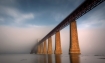
The 2.5 km. (1.5 mile) Forth Railway Bridge, the world’s first major steel bridge, with its gigantic girder spans of 521 m. (1710 ft.) ranks as one of the great feats of civilization. It was begun in 1883 and formally completed on 4 March 1890 when HRH Edward Prince of Wales tapped into place a ‘golden’ rivet.
The main crossing comprises tubular struts and lattice-girder ties in three double-cantilevers each connected by 105 m. (345 ft.) ‘suspended’ girder spans resting on the cantilever ends and secured by man-sized pins. The outside double-cantilever shoreward ends carry weights of about 1000 tonnes to counter-balance half the weight of the suspended span and live load.
Each of the 110 m. (361 ft.) high double-cantilevers is supported on well-founded granite faced piers. The bridge’s construction involved the employment of 4,000 men at times, the use of 54,000 tonnes of steel and driving 6,500,000 rivets. Its total cost was £3,200,000 (~£235,000,000 today).
During operations, rescue boats were stationed under each cantilever saving at least 8 lives, but still 57 men lost their lives.
Today, the bridge, Scotland’s biggest ‘listed’ building, continues to form a vital artery in Network Rail's East Coast railway system; it carries 180 - 200 train movements per day.










Publikuj.
Ogólnie mało jest architektury w GW; 2 strony tylko, a portretu 10 ;)
Pozdrawiam :)))
To most stalowy więc pokazanie jego ciężkości wskazane jest.
Reszta to takie pitolenie o wszystkim i o niczym, szukanie dziury w całym.
dziadek tez taki sam widac to rodzinne ;)
bardzo gratuluję wyróżnienia Mirku,
zasłużone również ze względu na postępy jakie poczyniłeś w fotografowaniu przez ostatnie miesiące, niesamowicie szybko się rozwijasz, brawo! :)
pozdrawiam i szczescia w nowym roku zycze :)
milo ze sie podoba :)
pozdrawiam bo mimo wszystko cie lubie :)))))